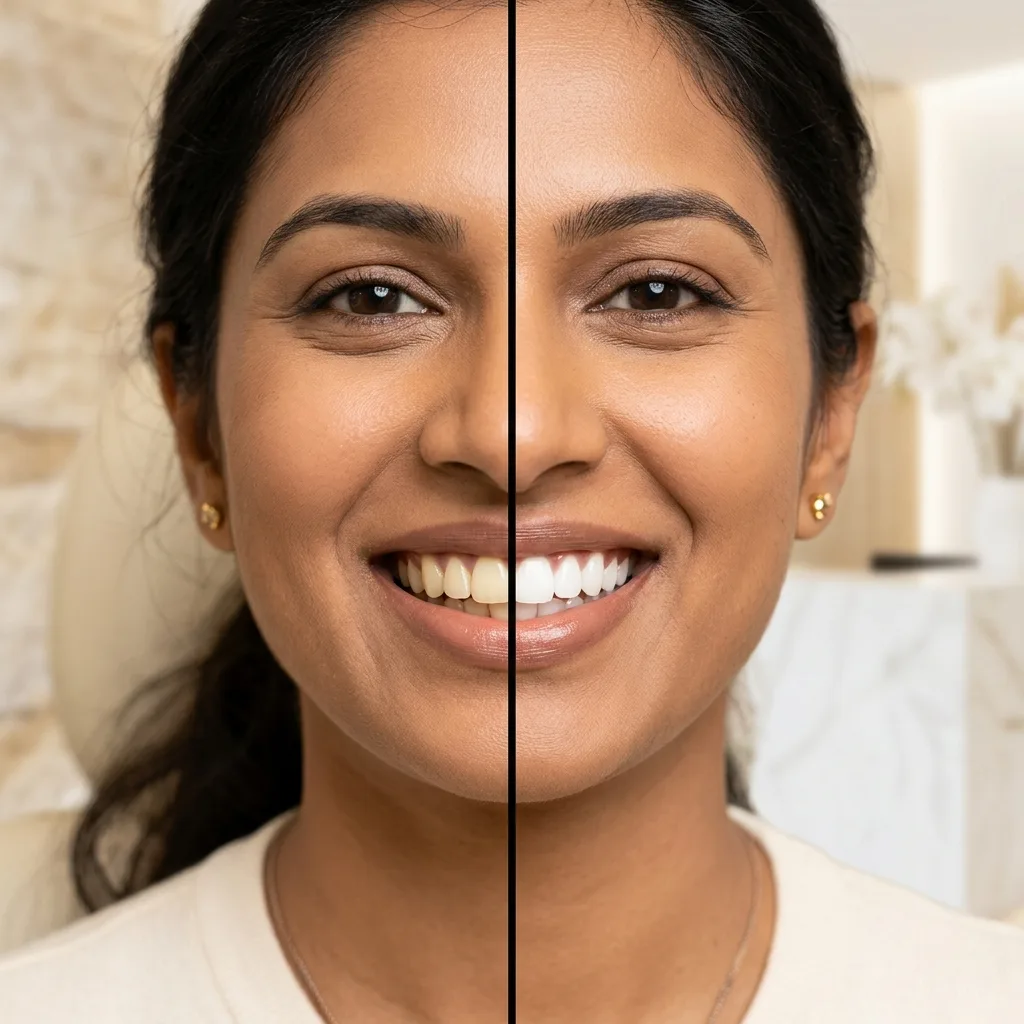
Whitening changes the colour of the tooth. It does nothing else. It does not clean the tooth, it does not repair it, and it cannot lighten anything that is not natural tooth structure. Most disappointment with whitening comes from expecting more than that, so this article starts with what the treatment can and cannot do, then walks through the visit and the days afterwards.
What whitening actually does
The visible colour of a tooth comes from two places: the outer enamel, which takes up stains from food and drink, and the dentine underneath, which is naturally yellower and shows through as enamel thins with age. Whitening uses a peroxide-based gel that moves into the enamel and breaks down the pigment molecules, so the tooth reflects more light. It lightens the tooth you already have. It does not make the surface smoother, and it does not remove tartar or plaque.
That is why a professional cleaning usually comes first. Scale and plaque sit on the surface and stop the gel reaching the enamel evenly, so whitening over a dirty tooth gives a patchy result. A cleaning is part of general dentistry, and it often improves the colour of the teeth on its own.
Who whitening suits
Whitening tends to work well when the discolouration is on or in the enamel:
- Stains from tea, coffee, red wine, tobacco or paan
- General yellowing that has crept up over the years
- A wish to go a few shades lighter before an event
It works less predictably on grey or brown discolouration that comes from inside the tooth. Examples include staining from certain antibiotics taken in childhood, excess fluoride during tooth development, or a tooth that has been injured or has had a root canal. Those cases often need a different approach, and your dentist can tell you which applies after looking at the teeth.
When whitening is the wrong choice
This is the part most whitening advertising leaves out. Whitening should wait, or should not be done at all, in these situations:
- Untreated decay or leaking fillings. Gel reaching exposed dentine is uncomfortable and can aggravate the problem. Treat the tooth first.
- Active gum disease. Inflamed gums react badly to peroxide. Bleeding gums need gum and periodontal care before anything cosmetic.
- Crowns, veneers, fillings and bonding. Restorations do not change colour. If you whiten the natural teeth around them, the restoration can end up looking darker by comparison, and it may need to be replaced to match.
- Very sensitive teeth or worn enamel. Whitening can make sensitivity worse. Your dentist may suggest treating the sensitivity first, or may advise against whitening.
- Pregnancy and breastfeeding. Most dentists advise postponing elective whitening. Ask your dentist.
- Children and young teenagers. The nerve of a young tooth is large and sensitive, and whitening is generally left until the teeth have matured.
If you are unsure which of these applies to you, the examination before whitening is where it is settled. It is a good reason not to buy over-the-counter kits or follow a social media shortcut without one.
What happens at the visit
The detail differs between clinics and between products, and your dentist will explain the method they recommend for you. The outline is usually this:
- Examination and shade check. The dentist looks for decay, gum problems and restorations, and records the starting shade so that any change can be compared honestly.
- Cleaning. Plaque and tartar are removed, as described above.
- Protecting the gums and lips. Peroxide burns soft tissue, so the gums are covered with a barrier before any gel is applied.
- Gel application. The gel is placed on the teeth and left for a set time, and may be refreshed during the visit. Some methods use a light or heat source; others rely on the gel alone.
- Rinse, removal of the barrier, and instructions. The dentist records the new shade and tells you what to avoid.
Some patients are also given trays to use at home under instruction. Whether that suits you is a decision for your dentist, based on your teeth and your history.
What you might feel during and after
Many people notice some sensitivity. Peroxide passes through the enamel, and the nerve of the tooth can react to cold air, cold drinks or sweet food for a day or two. It normally settles by itself. If it does not settle, or if the pain is sharp or spontaneous, contact your dentist rather than waiting, because that can mean something other than ordinary whitening sensitivity. The gums may also look slightly pale or feel sore for a short time where gel touched them.
What to expect from the result
The shade you end up with depends on where you started and on the type of staining. Teeth that are yellow tend to respond better than teeth that are grey, and no one can promise a particular shade in advance. Results also do not last forever. Colour drifts back as the teeth take up new stains, and how fast that happens depends mostly on what you eat, drink and smoke, not on the clinic.
A tooth also looks lighter immediately after treatment partly because it is temporarily dehydrated, and the shade settles slightly in the following days. Judge the result after about a week, not in the chair.
Looking after the result
- For the first couple of days, avoid tea, coffee, red wine, cola, curry sauces and tobacco, since the enamel is more receptive to stain just after whitening. Your dentist will tell you how long to keep to this.
- Brush twice a day with a fluoride toothpaste. A toothpaste made for sensitive teeth can help if you are uncomfortable.
- Rinse with water after dark drinks, and use a straw where practical.
- Keep up regular check-ups and cleanings. Surface stain builds up again and a cleaning removes much of it.
- Ask before repeating whitening. Overuse can leave teeth sensitive, and the right interval depends on your teeth.
Whitening at Dr C Dental Clinic, Kompally
Dr C Dental Clinic is at Sy No 204, Floor 2, Fairmount Square, Medchal Road, opposite CinePlanet, service lane towards Suchitra Circle, Kompally, Telangana 500100. It is open Monday to Saturday, 10:00 to 20:00, and on Sunday from 10:00 to 14:00 by appointment. To find out whether whitening suits you, contact us to arrange an appointment, or call +91 96426 56568.
This article was written by Dr. Jaya Lakshmi, BDS, General Dentist. It is general information and is not a substitute for an examination of your own teeth.