Laser Dentistry: What Dental Lasers Really Do in Gum and Soft-Tissue Treatment
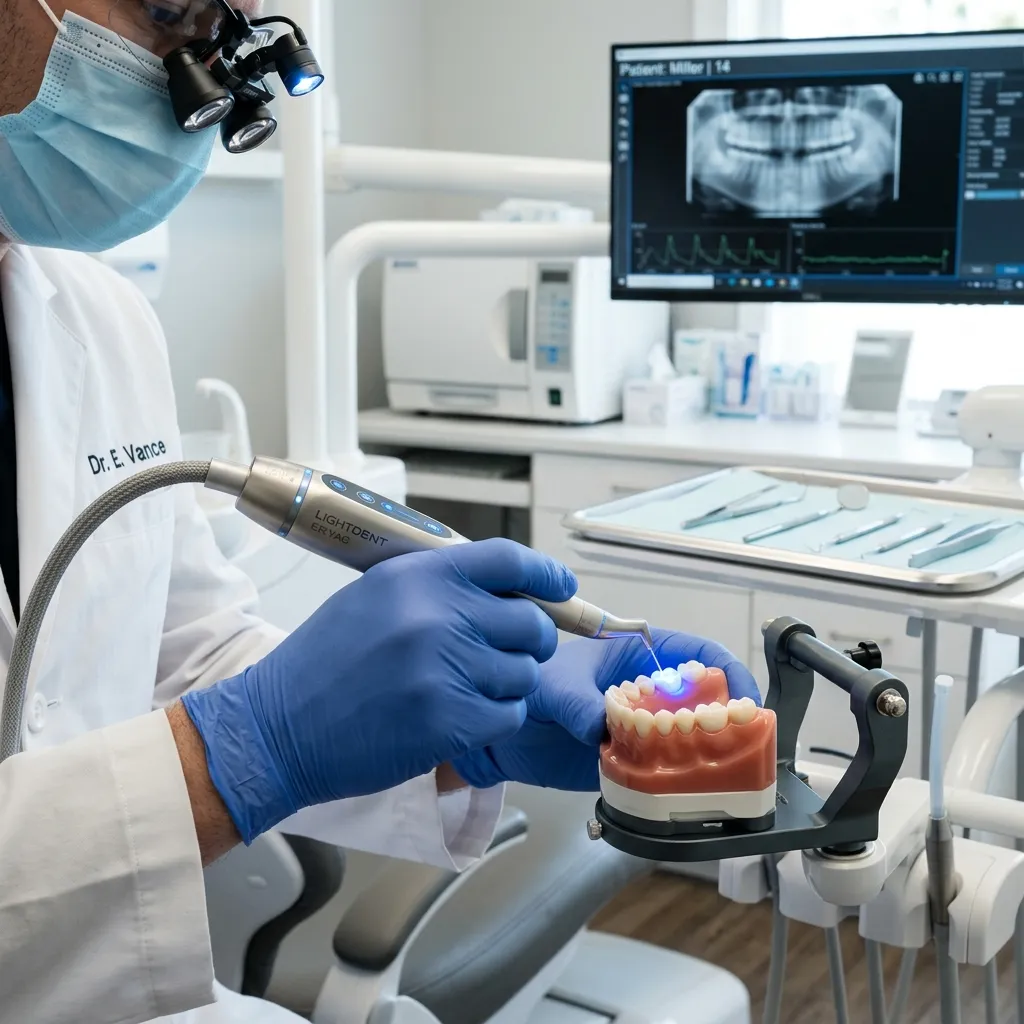
A dental laser is a focused beam of light tuned to a specific wavelength, used to cut, reshape or disinfect tissue. In practice it is most useful for soft tissue — gums, the lining of the cheek, the small flap of tissue over an erupting wisdom tooth — and as an addition to gum treatment rather than a replacement for it. It is a tool with a narrow set of genuine advantages, not a different kind of dentistry.
I want to be straightforward about one thing first, because the phrase "painless laser dentistry" circulates widely. A laser does not remove sensation. Many soft-tissue laser procedures can be done with little or no injection, and most people describe the sensation as warmth or pressure rather than sharp pain. But that depends on the procedure, the depth of tissue involved and the individual. Anaesthetic is still used when it is needed.
How a laser differs from a scalpel or a drill
The light energy is absorbed by water or pigment in the tissue and converted to heat, which vaporises a very thin layer. Three practical consequences follow:
- Less bleeding in soft tissue. The same heat that cuts also seals small blood vessels, so the working field stays clearer and sutures are often unnecessary.
- No vibration or whine. For patients whose anxiety is tied specifically to the sound and feel of a drill, this matters more than anything technical.
- A narrower cut. The beam removes tissue in fractions of a millimetre, which helps when reshaping a gum margin by a small, deliberate amount.
Against that, a laser cuts slowly compared with a blade, it generates heat that has to be controlled, and it cannot do several things a drill or a hand instrument does easily. Both patient and team wear wavelength-specific eye protection throughout — that is not optional.
Which procedures a laser genuinely suits
Gum disease treatment
In periodontal work, a laser is used after mechanical cleaning to disinfect the pocket between gum and tooth and remove inflamed lining tissue. The important word is after. A laser cannot remove hardened calculus from a root surface; that still requires careful scaling and root planing with instruments. Where a laser can help is in reducing bacteria in a deep pocket and settling inflamed tissue that bleeds at the slightest touch. It is an adjunct, and the evidence for how much it adds to thorough mechanical cleaning is honestly mixed. If anyone tells you a laser alone will cure gum disease, be sceptical. You can read more about the overall approach on our page on gum and periodontal care.
Soft-tissue surgery
This is where lasers are most clearly useful:
- Gum reshaping before veneers or crowns, or to even out an uneven gum line, when only soft tissue needs to move and the underlying bone is at a healthy level.
- Frenectomy — releasing a tight band of tissue under the tongue or lip, including tongue-tie in infants and children.
- Removing the flap of gum over a partially erupted wisdom tooth that keeps trapping food and becoming sore, when the tooth itself can be kept.
- Treating mouth ulcers and cold sores, where a brief laser application can reduce discomfort while the lesion heals.
- Desensitising exposed root surfaces that react sharply to cold.
What the appointment feels like
Most soft-tissue laser procedures take ten to thirty minutes. A single quadrant of laser-assisted gum treatment usually runs longer, and full-mouth treatment is normally split across visits. You will notice a faint smell during the procedure — that is vaporised tissue, and it is expected. There is no spray of water and no vibration. Afterwards, the area feels tender in the way a graze feels tender, generally for two to four days. Numbness, when anaesthetic is used, wears off over a couple of hours as usual.
Recovery and aftercare
- Eat soft, lukewarm food for the first day. Avoid chillies, very hot tea or coffee, and anything crunchy on the treated side.
- Do not rinse vigorously or use a straw on the day of treatment.
- Keep brushing — gently, with a soft brush, including near the treated area unless you were told otherwise. Plaque left on an inflamed gum undoes the work.
- No tobacco, gutka or paan. Smokeless tobacco and smoking both slow gum healing and are the single most common reason treated gums fail to settle.
- A whitish film over the treated gum after a day or two is normal healing tissue, not infection. Leave it alone.
- Call us if bleeding does not stop, if swelling increases after the third day, or if pain worsens rather than easing.
Most people go back to work or college the same day or the next.
Where a laser is not the right tool
This section matters more than the rest. A laser is unsuitable or simply unnecessary for:
- Removing calculus. Hardened deposits need mechanical instruments. No laser substitutes for that.
- Advanced bone loss. When gum disease has destroyed supporting bone, flap surgery, grafting or regenerative procedures are what change the outcome. A laser does not regrow bone.
- Deep cavities and crown preparation. Some lasers can remove early decay, but for a deep cavity, a crown preparation, or removing an old filling or crown, a handpiece is faster and more precise. Treatment inside the tooth is handled with rotary instruments — see root canal treatment.
- Any white, red or non-healing patch that needs a diagnosis. Heat from a laser distorts the edges of a tissue sample and can make the pathologist's job harder. If a lesion needs a biopsy, a blade is the correct instrument. This is particularly relevant for anyone with a tobacco or paan habit.
- Extractions and implant placement. A laser may assist with the soft tissue, but the procedure itself is surgical. Planning for dental implants depends on imaging such as 3D CBCT, not on the cutting instrument used.
There are also specific cautions — certain lesions, some medical conditions and pigmented tissue respond differently — which is why the decision is made after examining you, not from a price list of procedures.
When to see a dentist
Do not wait for a laser-specific reason. Come in if your gums bleed when you brush, if they have receded, if a tooth feels loose or has shifted, if you have persistent bad breath, or if you have a mouth ulcer or patch that has not healed in two weeks. Bleeding gums are not normal and they rarely settle on their own. Earlier assessment usually means simpler treatment, with or without a laser. Our clinical team can tell you which parts of your treatment a laser would genuinely help and which it would not.
If you would like your gums assessed, call +91 96426 56568 or book an appointment at our Kompally clinic. We are open Monday to Saturday, 10 AM to 8 PM, and Sunday 10 AM to 2 PM by appointment.