Most dental problems in children are preventable, and most are easier to deal with when they are caught early. The difficulty for parents is knowing what to do and when: when the first visit should happen, whether baby teeth really matter, what a sealant is, and whether a child's crooked teeth need attention now or later. This article answers those questions in plain terms, and explains what to expect from a child's visit to a dental clinic. It is written by Dr. Jaya Lakshmi, a general dentist at Dr C Dental Clinic in Kompally.
When should a child first see a dentist?
The usual advice from dentists is to book a first visit around the time the first tooth appears, and in any case by the first birthday. At that age there is rarely anything to treat. The visit is for checking how the teeth and gums are developing, answering questions about feeding, bottles, pacifiers and thumb-sucking, and showing the parent how to clean a very small mouth. It also lets the child meet the clinic while nothing uncomfortable is happening, which makes later visits easier.
If you have missed that window, a child of any age can still have a first check-up. The hardest first visit is one that happens in pain, so earlier is better.
Why baby teeth matter
It is common to hear that baby teeth do not need care because they fall out anyway. That is a misunderstanding, and it is worth correcting:
- Decay hurts and spreads. A decayed baby tooth can cause toothache, swelling and infection, and a child in pain eats and sleeps badly.
- They hold space. Baby teeth keep a place open for the adult tooth underneath. If one is lost far too early, the neighbouring teeth can drift into the gap and the adult tooth may come in crowded or out of position.
- Habits start here. A child who learns to brush twice a day at three keeps the routine at thirteen.
What causes cavities in children, and how to reduce them
A cavity forms when bacteria in plaque turn sugar into acid, and the acid slowly dissolves the enamel. The number of times a child has sugar matters more than the amount at any one time, because each exposure keeps the mouth acidic for a while afterwards. So the practical steps are mostly about frequency:
- Keep sweets, biscuits, sweetened drinks and juice to mealtimes rather than spread through the day.
- Do not put a child to bed with a bottle of milk or juice, or let them fall asleep feeding, once teeth have come through.
- Brush twice a day, including last thing at night, with a smear of fluoride toothpaste for young children. A parent should do or supervise the brushing until the child can manage it properly, which is usually well into the school years.
- Have regular check-ups, so that anything starting is seen while it is still small.
Sealants: protecting new back teeth
The first permanent molars come through at around six years of age, behind the baby teeth, and many parents do not notice them arriving. These teeth have deep grooves on the biting surface that are hard to clean with a toothbrush, and they are a common place for early decay. A sealant is a thin coating of resin painted over the grooves to keep plaque out. Placing one does not involve drilling or an injection, and it is usually quick. They do not replace brushing and need checking at regular visits. Whether a particular child's teeth are suitable is something the dentist decides at the examination.
Space maintainers
When a baby tooth has to be removed early because of decay or injury, the gap can close as the neighbouring teeth move. A space maintainer is a small appliance that holds the gap open until the adult tooth is ready to come through. Not every early loss needs one. It depends on which tooth was lost, how old the child is and how close the adult tooth is to erupting, and the dentist can judge that from the examination and an X-ray.
Dental injuries
Children fall, and teeth get knocked. If a permanent tooth is knocked out completely, it is an emergency and time matters. Hold it by the crown rather than the root, do not scrub it, and get to a dentist straight away. A tooth that has been put back quickly has a better chance of being saved. If a tooth is chipped, loosened or pushed out of position, or if a baby tooth changes colour after a knock, the child should be seen. Call 096426 56568 rather than waiting for a routine appointment.
What a child's visit involves
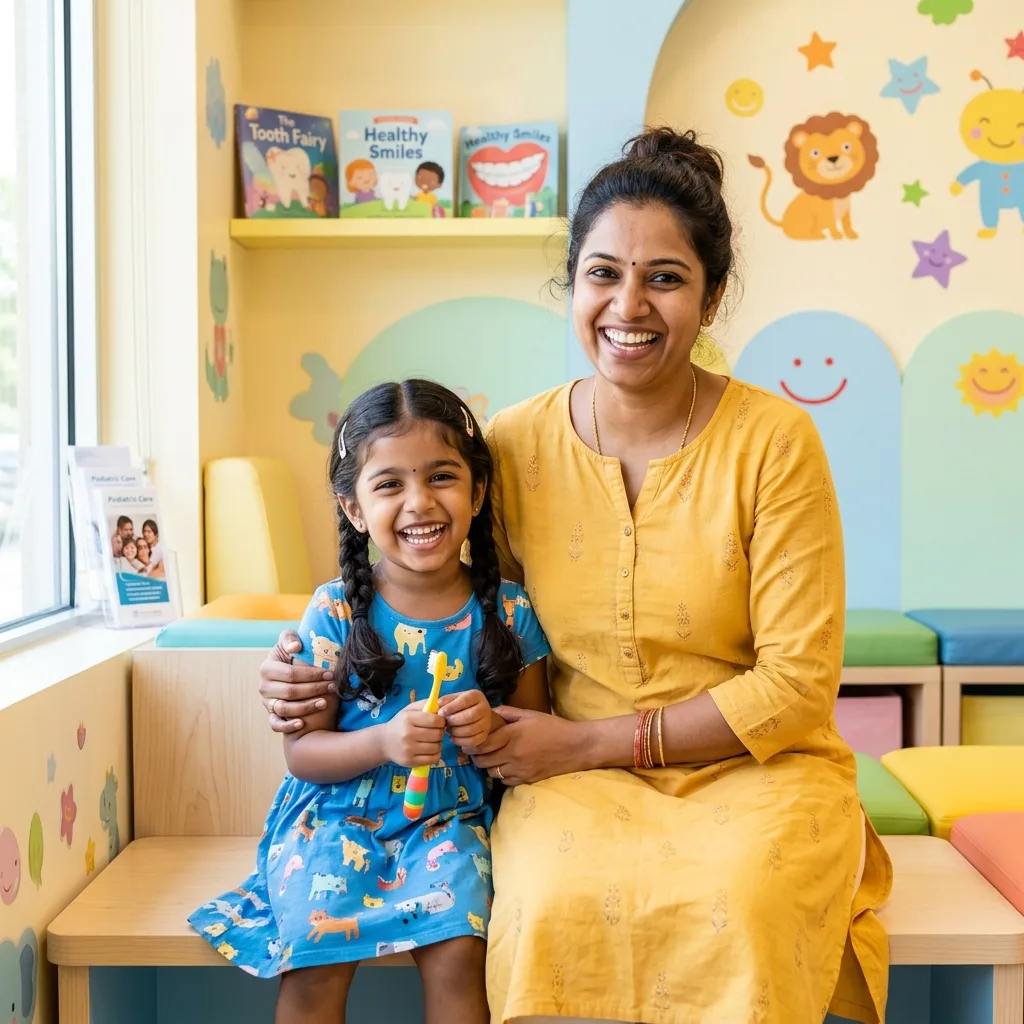
The details depend on the child's age and what the dentist finds. A first visit is generally gentle and mostly about talking and looking. The dentist counts and examines the teeth, checks the gums, the tongue and the way the teeth meet, and may take an X-ray if there is a reason to. The dentist then talks to the parent about brushing, diet and any habits. For a young or nervous child, it often helps if the visit does not start with any treatment at all. Telling the child honestly what will happen, in simple words, works better than promising that nothing will happen.
Teenagers
Teenage visits shift towards different concerns. Braces and retainers need careful cleaning, and gum inflammation around brackets is common without it. Wisdom teeth start to form in the late teens and are monitored with X-rays when needed. Teenagers who play contact sports should ask about a mouthguard, since a properly fitted guard protects against injury to the teeth and lips.
When to ask about an orthodontic check
Many orthodontic problems are best assessed during childhood, because the jaws are still growing and the dentist can see how the adult teeth are coming through. The orthodontic specialists generally suggest a check at around the age of seven, which is the time the first permanent teeth and the bite can be assessed. It is a look, not necessarily a start to treatment. Often the answer is to wait and review, and many children need nothing more than monitoring until the adult teeth are in. Signs that are worth raising earlier include:
- Teeth that are crowded or that overlap significantly
- Upper teeth that sit far forward, or lower teeth that sit in front of the upper ones
- Front teeth that do not meet when the back teeth are closed
- Baby teeth lost much earlier or much later than expected
At Dr C Dental Clinic, orthodontic assessment is done by Dr. Suhas Adabala, who holds an MDS in Orthodontics. Braces and aligner options are described on the orthodontics page.
Booking a children's check-up in Kompally
Dr C Dental Clinic is on Medchal Road in Kompally, opposite CinePlanet, and sees families from Kompally, Suchitra, Alwal, Medchal and Dullapally. You can read about the clinic's approach to children on the paediatric dentistry page, or book an appointment and tell the team your child's age and any worries, so that the visit can be planned around them.