Eco-Friendly Dentistry: What a Clinic Can Reduce, and What It Must Not
Sustainable dentistry is mostly unglamorous. The real reductions in a dental clinic come from a small number of places: replacing film X-rays with digital sensors, cutting single-use plastic that was never necessary, managing water in the suction and sterilisation systems, and segregating waste so that metals and chemicals do not reach the drain. One category is not negotiable at all — infection control. A clinic that reuses a disposable item to save plastic is not being environmentally responsible; it is being unsafe.
Here is what is actually reducible, what is fixed, and the few things you can change as a patient that matter more than which toothbrush you buy.
What a clinic can genuinely reduce
Digital imaging instead of film
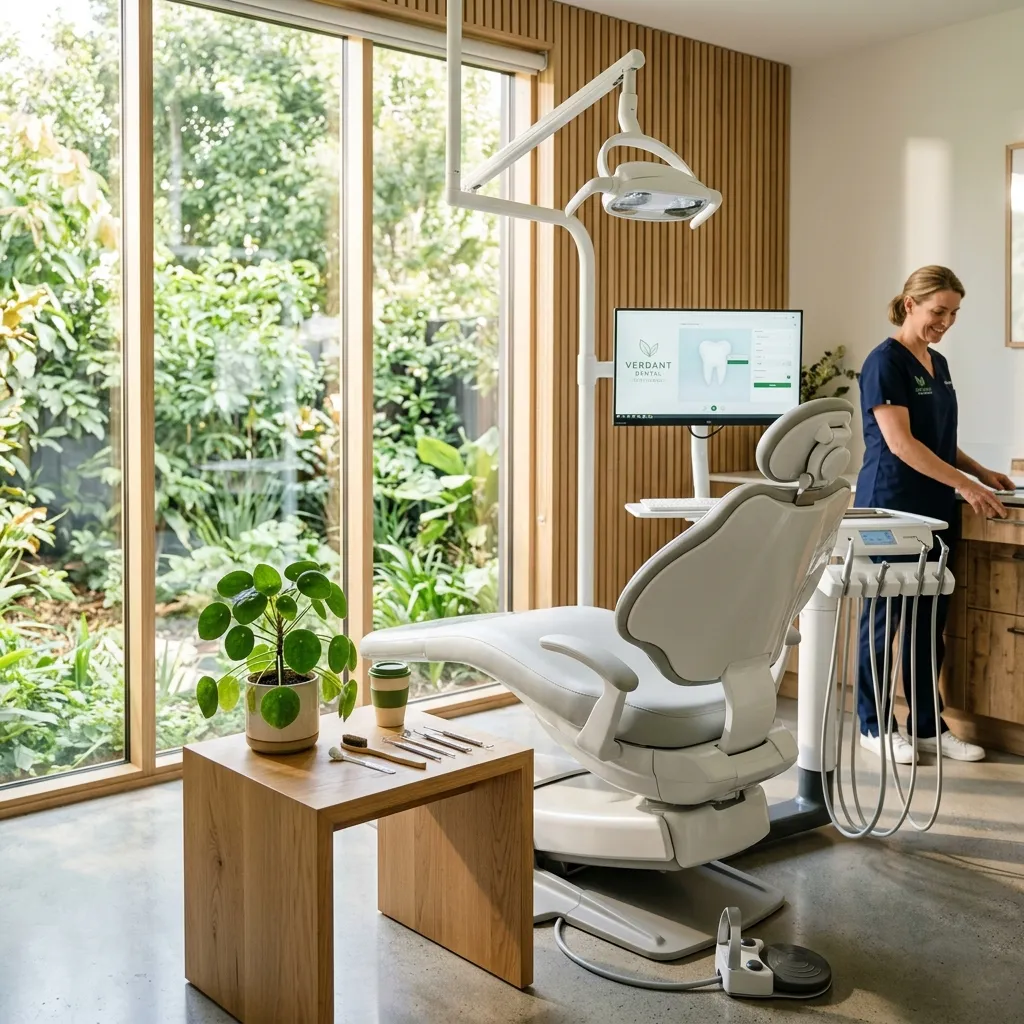
Film radiography needs developer and fixer solutions, lead foil and a darkroom. The chemistry is hazardous, has to be collected and disposed of correctly, and the lead has to go somewhere. Digital sensors remove all of that. They also reduce retakes, because a poorly angled or underexposed image shows up immediately rather than after processing, and digital capture generally requires a lower radiation dose than film for the same view. At our clinic, routine views are taken with digital RVG X-ray, and 3D CBCT imaging is used where a three-dimensional assessment genuinely changes the plan — implant positioning, an impacted wisdom tooth close to a nerve, a complex root anatomy.
That last point is the honest caveat. A CBCT scan is a larger dose than a single small radiograph. It should be taken when the extra information will change what is done, not as a routine screen.
Single-use plastic that does not need to be single-use
A good deal of plastic in a dental surgery is habit rather than requirement: barrier films on surfaces that could be wiped and disinfected instead, plastic cups where no rinse is needed, over-packaged kits, sterile packs opened "just in case" and discarded unused. Setting out a tray for the procedure that is actually planned, rather than a maximal tray, removes a surprising volume of waste over a week. Stainless steel instruments — mirrors, probes, forceps, extraction instruments — are washed, packed and autoclaved rather than thrown away, and that is both the safer and the lower-waste route.
Water
Older wet-ring suction systems use a continuous stream of water to generate vacuum, and over a full working day that adds up considerably. Dry vacuum systems avoid it. Autoclave cycles, ultrasonic cleaning and waterline flushing all consume water too, and the realistic saving there comes from running full loads instead of half loads — never from shortening a sterilisation cycle.
Waste segregation and amalgam separators
Dental waste is not one thing. Sharps, extracted teeth, blood-contaminated cotton, chemical waste and ordinary packaging each have a different route, and segregating them at the chairside is what keeps the hazardous fraction small. Where silver (amalgam) fillings are placed or removed, an amalgam separator fitted to the suction line traps the mercury-containing particles so they are collected for safe handling rather than washed into the sewage system. Amalgam is used far less than it once was in routine general dentistry, but it is still removed from older teeth, and that is exactly when a separator earns its place.
Treatment that does not need redoing
This is the largest and least discussed saving. Every repeat appointment has a footprint — instruments, sterilisation, materials, packaging, and your travel. Accurate diagnosis, a properly isolated and sealed restoration, a root canal completed to the full working length, and gum treatment that is actually followed through all reduce the number of times the same tooth has to be treated again. Prevention does more than any disposable swap: a filling that never has to be placed is the cleanest option available.
What cannot be compromised
Some items must stay single-use, and no sustainability argument changes that:
- Needles, blades, sutures and local anaesthetic cartridges. One patient, then disposed of as sharps.
- Gloves, masks and suction tips. Changed between patients.
- Polishing cups and brushes, impression materials, saliva ejectors, matrix bands and burs beyond their rated use. Reprocessing these is not reliable.
- Full autoclave cycles with cycle monitoring. Sterilisation is verified, not assumed, and the energy and water it uses is simply part of safe dentistry.
- Protective items for you. A bib or eye protection is cheap; a cross-infection is not.
If a clinic is reusing items from that list, the problem is not its environmental policy.
Where "eco-friendly dentistry" claims go wrong
A few things sold as green are, at best, neutral:
- Charcoal toothpastes and powders. Often abrasive, frequently without fluoride, and abrasion wears enamel permanently. A natural ingredient list is not the same as a safe formulation.
- "Chemical-free" or fluoride-free as a selling point. Fluoride at toothpaste concentrations is one of the better-established preventive measures in dentistry. Removing it to sound natural makes decay more likely, and decay means more treatment.
- Bamboo brushes with no attention to technique. The handle material matters far less than whether you reach the gum margin twice a day.
- Delaying needed treatment to "avoid intervention". A small cavity treated early uses a fraction of the materials, visits and travel of the same tooth treated late. Postponement is not a low-impact choice.
What you can usefully do
- Choose a soft-bristled brush and use it properly. Replace it when the bristles splay, not on a calendar. A manual brush used well is not inferior to an electric one; an electric brush helps if your technique is rushed or your dexterity is limited.
- Turn the tap off while brushing. Two minutes of running water, twice a day, is the single easiest change in this whole article.
- Combine appointments. If you are travelling in from Alwal, Medchal, Dullapally or Jeedimetla, ask whether a check-up, a scaling and a family member's appointment can be scheduled on the same visit. Fewer trips across North Hyderabad traffic is a genuine reduction, and it saves you a morning.
- Keep your gums under control. Gum disease is the most common reason teeth need repeated attention, and it is largely manageable at home once you have been shown what to do. Tobacco and paan use make it considerably harder.
- Do not hoard half-used mouthwashes and whitening kits. Buy what has been recommended for your situation; most of it is unnecessary for most people.
When to see a dentist
Independent of any of this, book an appointment if you have bleeding gums, a tooth that is sensitive to cold for more than a few seconds, pain on biting, a swelling in the gum or face, a broken filling with a sharp edge, or a mouth ulcer that has not healed in two weeks. A routine check-up and cleaning once or twice a year, depending on your gum condition, is what keeps problems small enough to treat simply.
If you would like a check-up or want to discuss a treatment plan, contact us or call +91 96426 56568. We are at Fairmount Square on Medchal Road in Kompally, opposite CinePlanet, Monday to Saturday 10 AM to 8 PM, and Sunday 10 AM to 2 PM by appointment.